Binary Number System: Representations
Principles of Floating Point Numbers
Calculations may have to deal with extremely large numbers and extremely
small numbers.
It would be wasteful to set aside all the digit space to handle (with
complete precision) numbers that require all these digits – especially
when the output will not require such precision. Further more –
if there was a fixed way to be certain to handle all possible numbers
– there would always come along a number that would require even
more digits.
Need to separate the range from the precision. We need some precision within a desired range. Some precision without having to have precision throughout the range.
Answer: scientific notation
Principles of Floating Point
scientific notation: n = f x 10e
f – fraction (or mantissa) e- a positive or negative integer called
exponent
computer version of scientific notation is floating point.
example: 3.14 = 0.314 x 101
range – determined by number of digits in the
exponent
precision – determined by the number of digits
in the fraction
(one form is usually chosen as the standard)
Floating-point used to model the real-number system of math – however some important differences.
+0.100 x 10-99 to +0.999 x 10+99
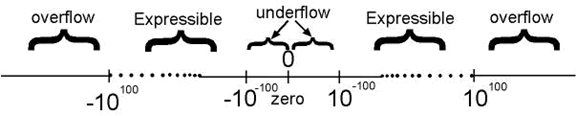
underflow can be less serious than overflow.
only 179,100 positive, 179,100 negative and one zero. That is 358,201 numbers out of the infinite number possible between the limits.
Some numbers (a result of calculation) can not be expressed with floating
point – therefore round.
rounding – using the nearest representation
Relative error for rounding is basically the same for smaller numbers
as for larger number.